Check out all of our collections!

Winter Hay Storage Tips
Tips on storing enough hay for your animals, and how to preserve, silage, and help your animals get the most out of off-season feedstuff.
Proper hay storage is critical for making sure your farm stays healthy and well-fed all winter long. As a staple food source, stockpiled hay needs to be protected from spoilage to reduce toxins and waste. Let’s look over some tips on storing enough hay for your animals, and how to preserve, silage, and help your animals get the most out of off-season feedstuff.
How to Store Enough Dry Matter Feed for the Winter
It can be helpful to feed your animals a little extra before winter arrives; livestock with healthier body condition scores handle weather stress better than leaner animals.
There are 4 factors that will affect your winter hay plan:
- How much to buy
- Your storage space
- Your hay producer (schedule, product quality, location)
- Your budget
Let’s tackle these factors one by one, starting with how to estimate the amount of hay or dry matter you will need for your animals.
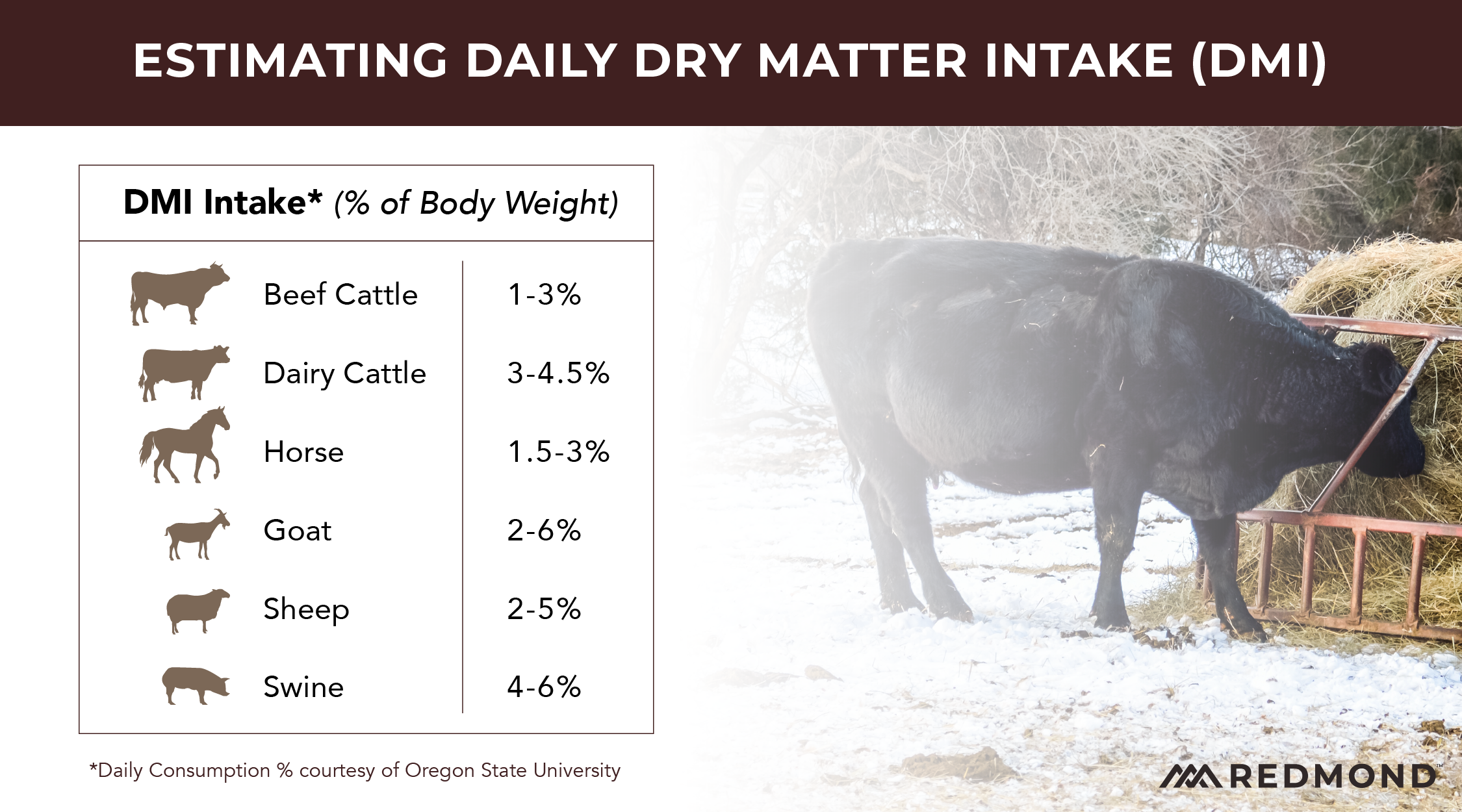
According to Dr. Susan Kerr of Oregon State University:
- Beef Cattle need to eat 1-3% of their weight in dry matter every day.
- Dairy Cattle: 3-4.5%
- Horses: 1.5-3%
- Goats: 2-6%
- Sheep: 2-5%
- Swine: 4-6%
As a general rule of thumb, as livestock animals mature and gain weight, their dry matter intake (DMI) percentage will decrease. Using the percentages above, here is a simple formula for projecting your hay needs for the winter.
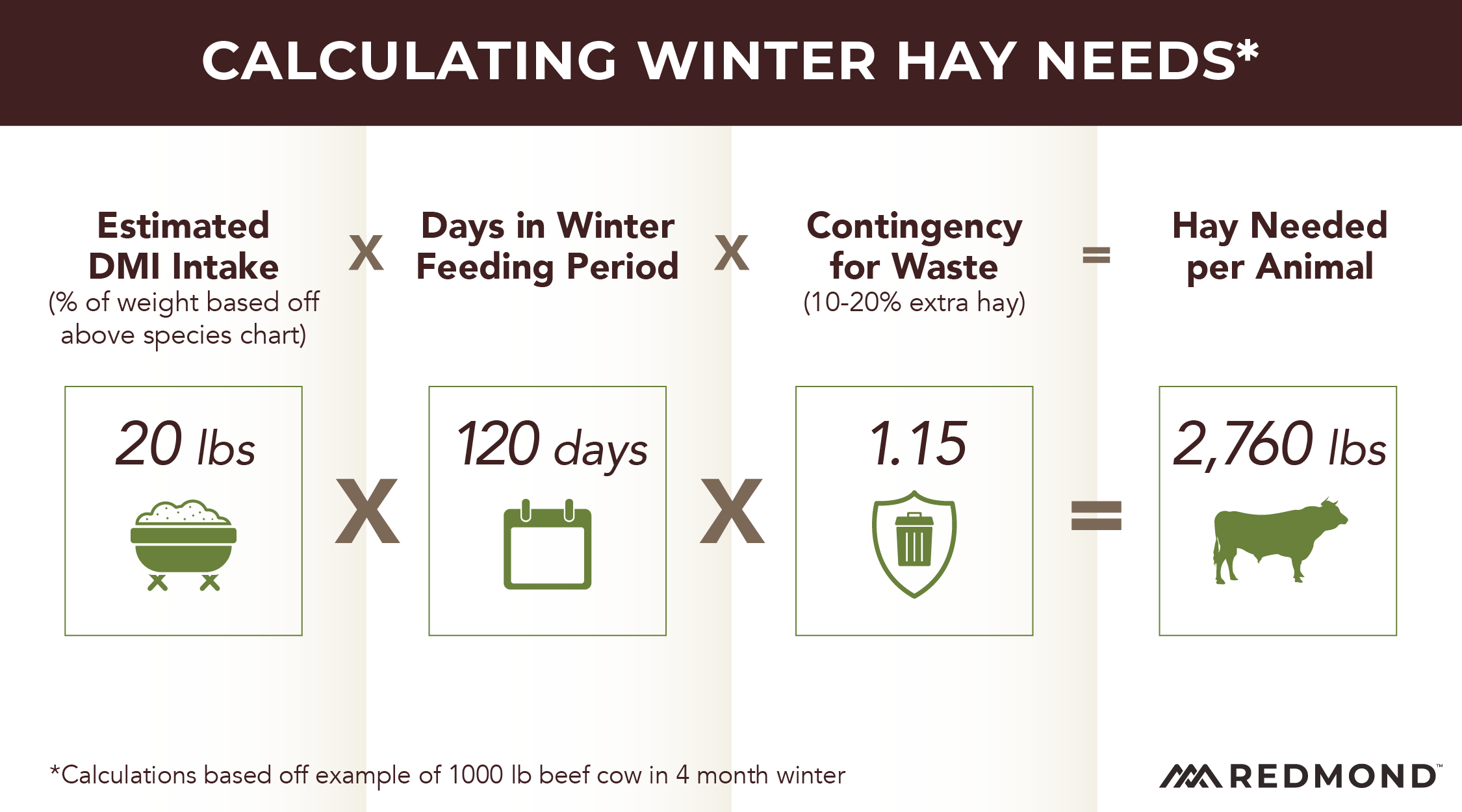
- First, calculate the estimated DMI for your animals. For example, a 1,000 beef cow eating around 2% of its weight, would need 20 lbs of hay every day.
- Second, multiply that weight by the number of days in your winter feeding period. The above graphic assumes a 4 month winter (add or subtract days depending on your location).
- Third, add a contingency for waste or loss by increasing your winter rations by 10-20%. Do this by multiplying by 1.1 (for 10% extra), 1.15 (for 15% extra), or 1.2 for (20% extra).
- Using this formula, a 1,000 lb beef cow would need around 2,760 pounds of hay for the winter. It is possible to purchase hay during the winter if you find you don’t have enough, but remember winter hay costs will be much higher.
Signs of Diet Balance During Winter
There are plenty of observable, physical cues you can look for to make sure your animals are getting enough to eat over the winter. For all livestock species, the following signs are evidence of a balanced diet:
- Good appetite
- Eyes are bright and clear of discharge
- No lameness or cracked hooves
- Healthy digestion (no diarrhea)
- Regular cud chewing in ruminants
- Weight gain (as appropriate)
- Healthy activity levels for their age and size (sleeping, walking, playing, etc.)
- Moderate body condition scores
- Normal reproductive functions
Winter Feed and Hay Storage Tips
Let’s look at some tips to help you with the next 3 factors affecting your winter hay: your storage space, your producer, your budget.
How to Store Winter Hay
- Use a solid, enclosed environment to store hay bales over the winter.
- Make sure the area will remain dry and well ventilated to prevent moisture and mold growth.
- Place on concrete or tarped foundation to prevent moisture from seeping up from the ground.
- Don’t pack stacks too tightly to allow for air circulation, reduce fire risk, and make it easier for you to periodically inspect for spoilage.
- If you don’t have enough barn or shed space, you can tarp above and below hay for storage (use tarped hay first as it will likely not last as long as hay in more secure storage.
- Remember that you are inadvertently creating an environment for pests, so take extra steps to protect stored forage from rodents who can contaminate it.
Reducing Spoilage
You have spent too much time, energy, and resources on feed for your animals to just lose it to spoilage.
Here are some tips for reducing spoilage:
- Feed to animals in reasonable batches (excess hay will likely get moved around and used for bedding)
- Find feeders that are the best fit for your animals (appropriately sized, placed, and covered to keep it clean and dry)
- Monitor supply over the winter by looking for roof leaks, discoloration, and signs of burrowing/droppings from pests.
- First in…first out (use older hay first and newer hay last)
Choosing Quality Hay
Planning winter feed is more than just counting hay bales; quality is just as important as quantity.
- Inspect the hay and look for full curing/dryness, mold, dust, and weeds that can affect the quality of your purchase.
-
Test your forage so you know how much crude protein (CP), relative feed value (RFV), and total digestible nutrients (TDN) are available to your animals.
-
Get to know your supplier so you have a better understanding of: where feed was grown, how and when it was harvested, how far it has traveled, and how it has been cared for.
Silage and Fermentation
Stored hay and corn can be silaged and fermented to increase the protein and energy available to your animals. Silaging is a careful science where bacteria colonies help “pickle” plant matter. For in depth instruction on how to safely and properly silage forage, click to learn more from Penn State Extension.
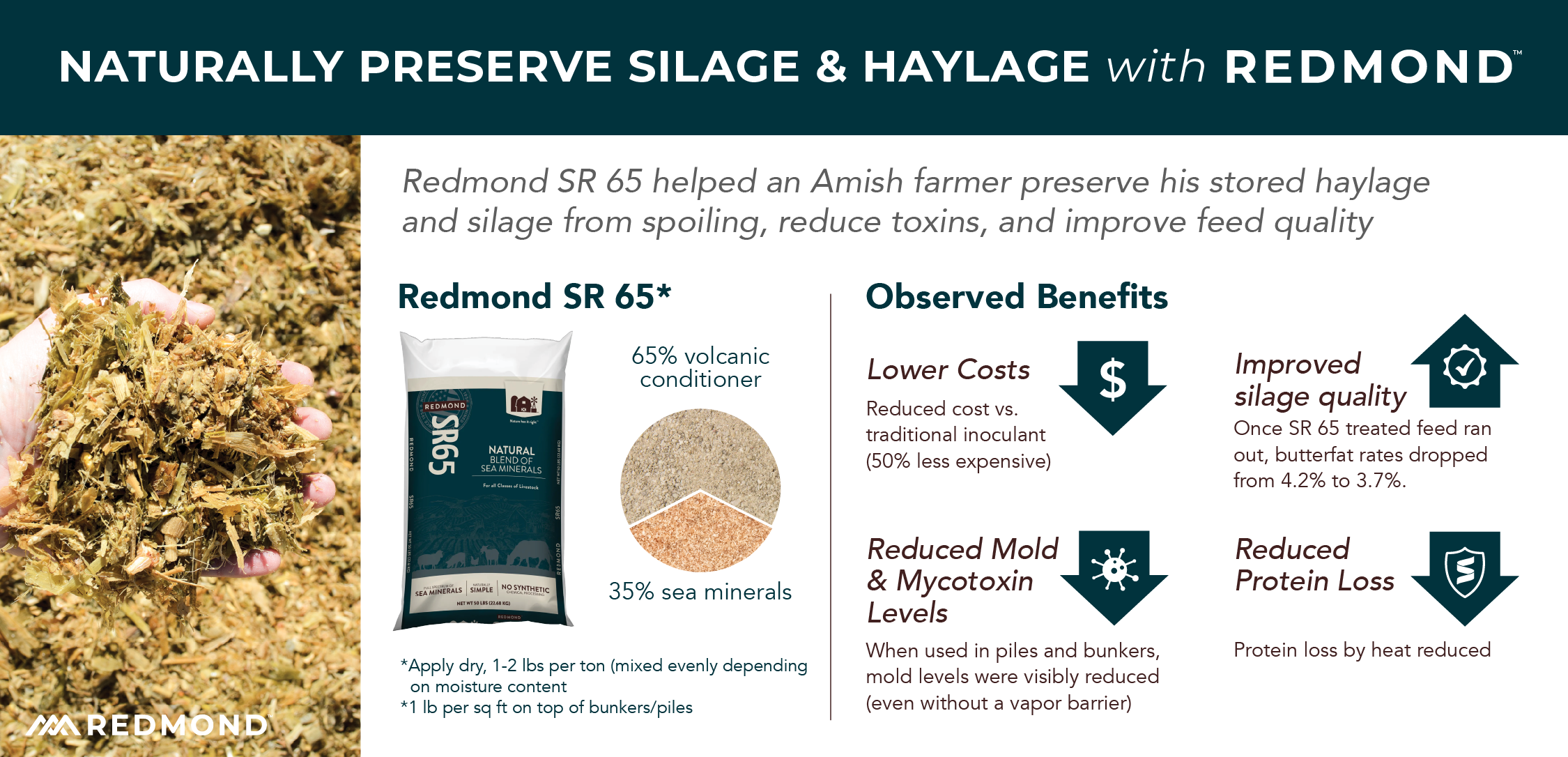
Did you know?...Redmond SR 65 can be used as a natural silage preserver. An Amish farmer applied our blend of sea minerals and volcanic bentonite clay to his silage and haylage and found a number of observable benefits:
- Lower mold and mycotoxin levels
- Higher butterfat rates from his dairy cows
- Less protein loss due to heat in the piles
Improve Winter Feed Efficiency with Redmond
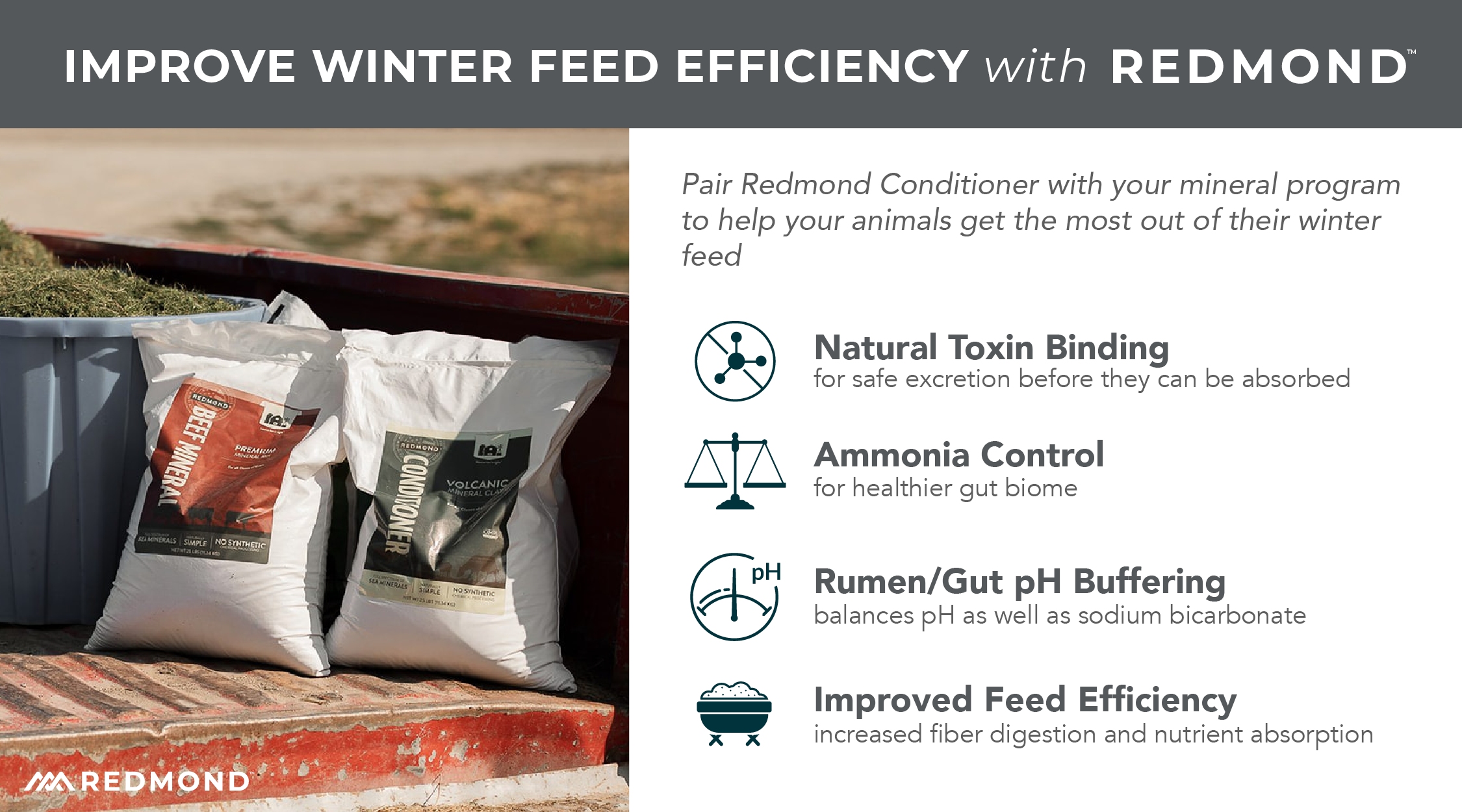
The benefits of Redmond’s sea and volcanic minerals don’t stop at silage preservation. Pairing Redmond volcanic conditioner with your mineral program is the perfect way to protect your animals’ health during the winter. Our natural sodium bentonite is beneficial for every livestock species:
- Binds to toxins in the gut for safe excretion before they can be absorbed
- Controls ammonia levels
- Buffers rumen/gut pH as well as sodium bicarbonate
- Increases feed efficiency by improving fiber digestion and helping your animals absorb more nutrients from their feed.
Give Redmond a call today to see how we can help your farm healthily weather the winter months ahead!
© 2026 Redmond Minerals Inc.